By Sarina Gomez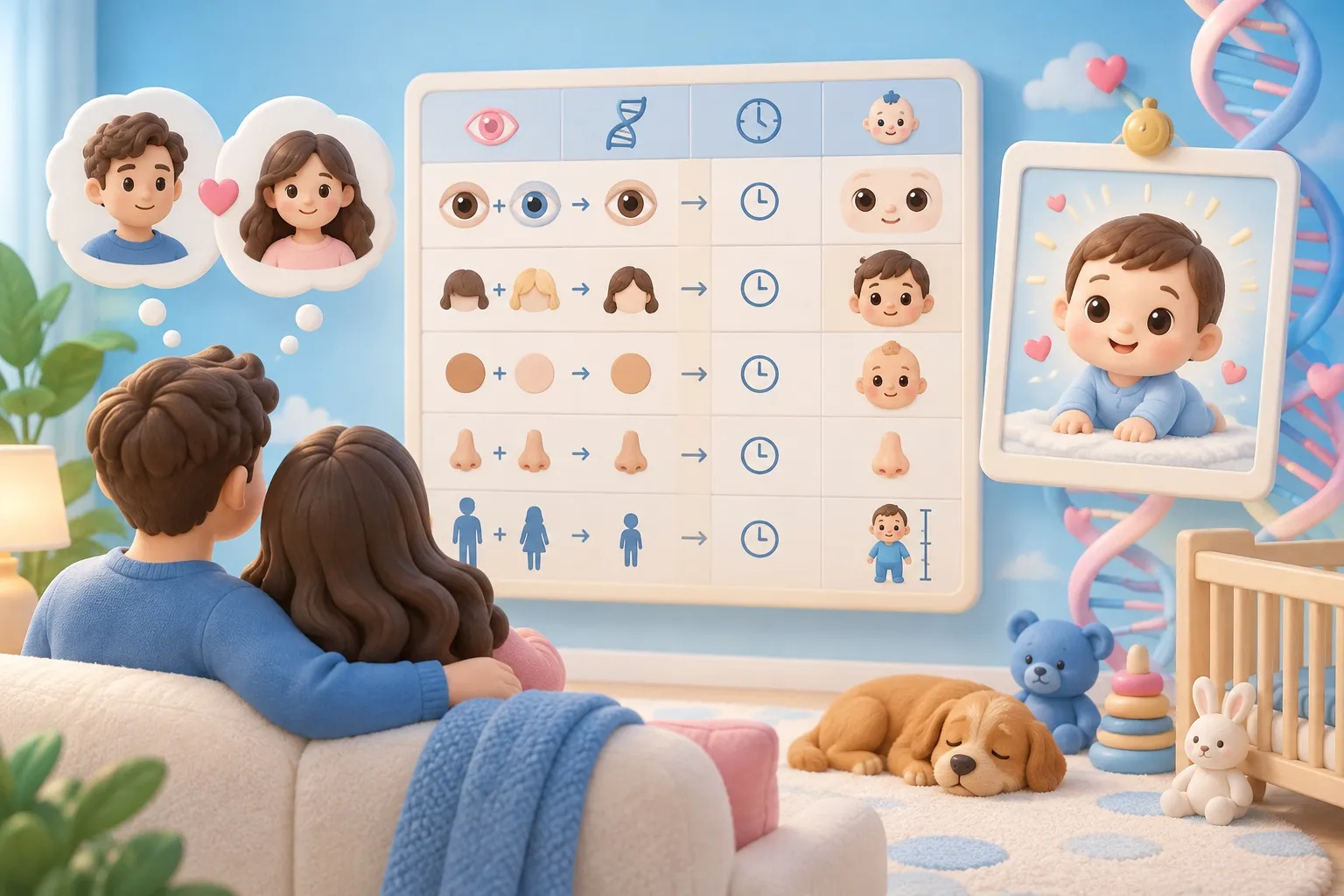
Your baby will look like a new mix of both families, and nobody can tell you the exact mix in advance. Almost every visible trait, from eye color to the shape of the nose, is shaped by many genes at once, so your two families’ features set the range of what’s likely without fixing the result. Some traits also take months or years to show their final form, which is why a newborn rarely looks the way they will at 3.
Here’s what’s known about each trait, what to expect at birth, and how to make an honest guess of your own.
The traits at a glance
Most features are polygenic: dozens or hundreds of gene variants each nudge the trait a little. That’s why simple “brown beats blue” charts get so many families wrong. The table sums up each trait; the sections below explain it.
| Trait | How it’s inherited | What’s likely | When it settles |
|---|---|---|---|
| Eye color | About 10 genes, led by OCA2 and HERC2 | Within the range of both families, including colors a parent carries but doesn’t show | Changes often start at 3–9 months; can take up to 3 years |
| Hair color | Many genes; MC1R is the main red-hair gene | Often between the parents; light hair often darkens with age | Newborn hair usually falls out in the first six months |
| Hair texture | Many genes, different ones in different populations | Hard to call from the parents alone | Can change as baby hair is replaced |
| Skin tone | Many genes | Usually within the range of both families; siblings can differ | All babies look lighter at birth and darken gradually |
| Nose and chin | Many genes; a few with measurable effects have been found | Family resemblance shows up more in the toddler years | Changes through childhood |
| Height | About 80% genetic, 700+ known variants | Usually near the average of the parents, adjusted by nutrition and health | Adulthood |
Sources for each row are linked in the sections below.
Eye color: many genes, slow to settle
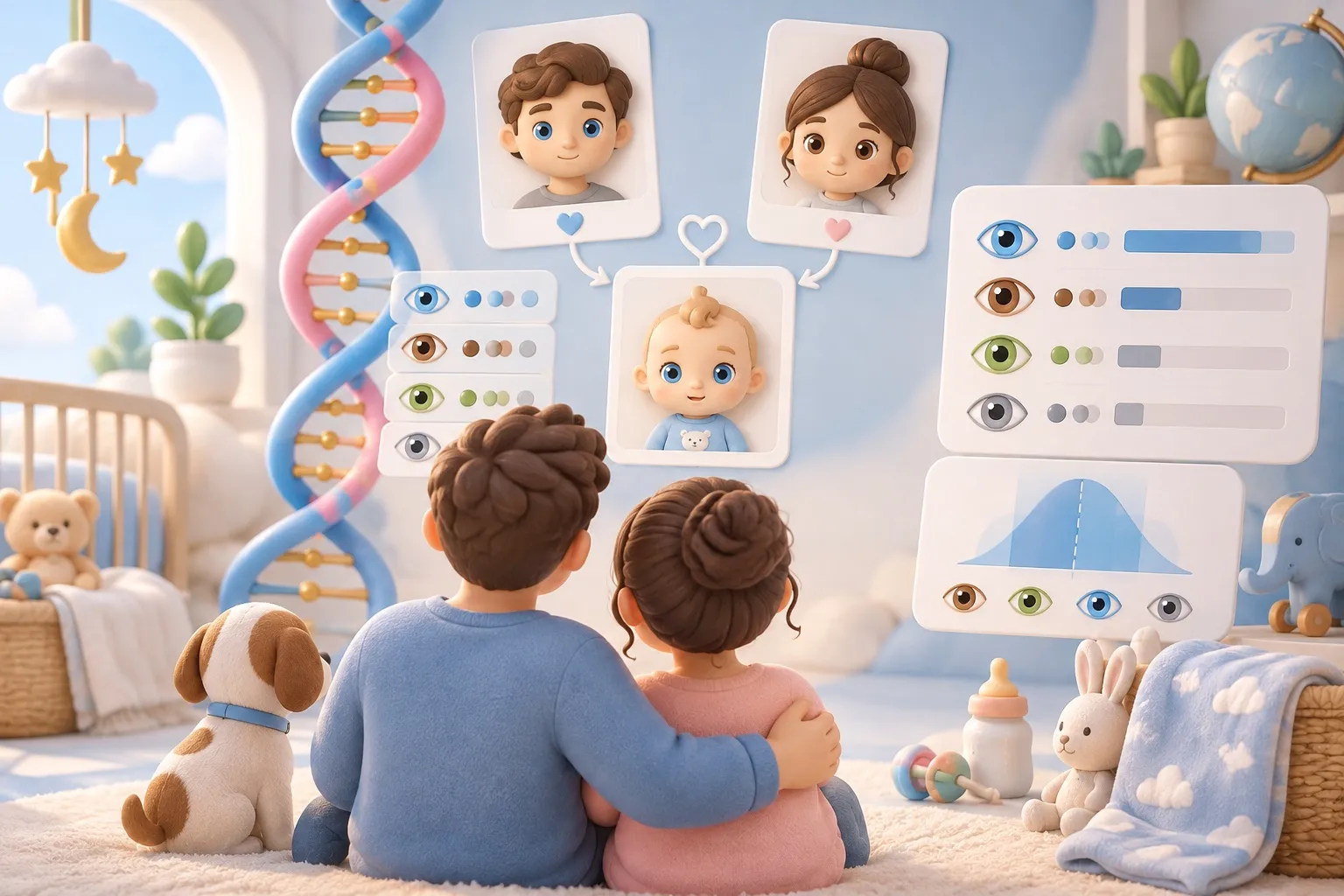
Eye color depends on how much melanin ends up in the front of the iris, and MedlinePlus Genetics lists about 10 genes that affect it. The two biggest, OCA2 and HERC2, sit next to each other; one common HERC2 variant turns OCA2 down, which means less pigment and lighter eyes.
Two practical results follow. Two brown-eyed parents can have a blue-eyed baby if both carry lighter variants. And a newborn’s eyes aren’t final: Cleveland Clinic says changes usually begin between 3 and 9 months, and the final color can take up to three years. The change nearly always runs from lighter to darker. Our guide to baby eye color has the full breakdown, with what each combination of parents makes likely.
Hair: color, texture and the newborn shed
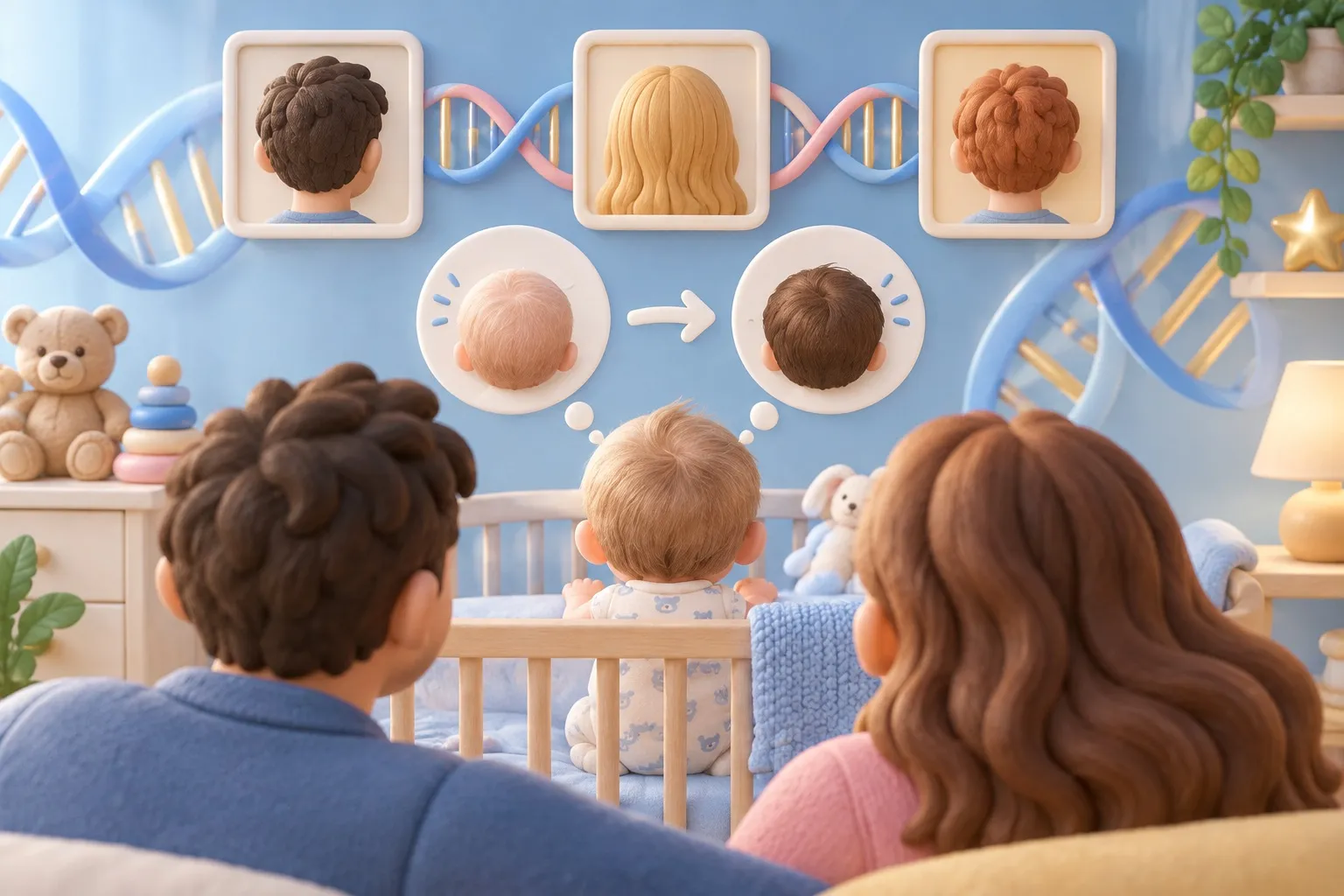
Hair color comes from the balance of two melanins, and MedlinePlus Genetics notes that many genes control it, “although little is known about most of them.” Red hair is the best understood: one altered copy of MC1R can give strawberry blond or auburn hair, and two copies almost always give very red hair. That’s why red hair can appear when neither parent is a redhead. Light hair also tends to darken as children grow.
Texture follows different rules again. MedlinePlus says different genes influence hair texture in different populations: variants in EDAR and FGFR2 affect hair thickness in Asian populations, and a TCHH variant affects texture in people of northern European ancestry. So “curly is dominant” is too simple; our post on curly hair genetics explains why.
Whatever hair your baby is born with is a preview, not the final version. The American Academy of Pediatrics says most, if not all, baby hair falls out during the first six months, and what grows back can differ in color and texture. More on that in baby hair color.
Skin tone: a family range, lighter at birth
Skin tone is polygenic too, so a baby usually lands somewhere within the range of shades in both families, and two siblings can land in different places. A baby can even end up lighter or darker than both parents if both carry variants they don’t visibly show.
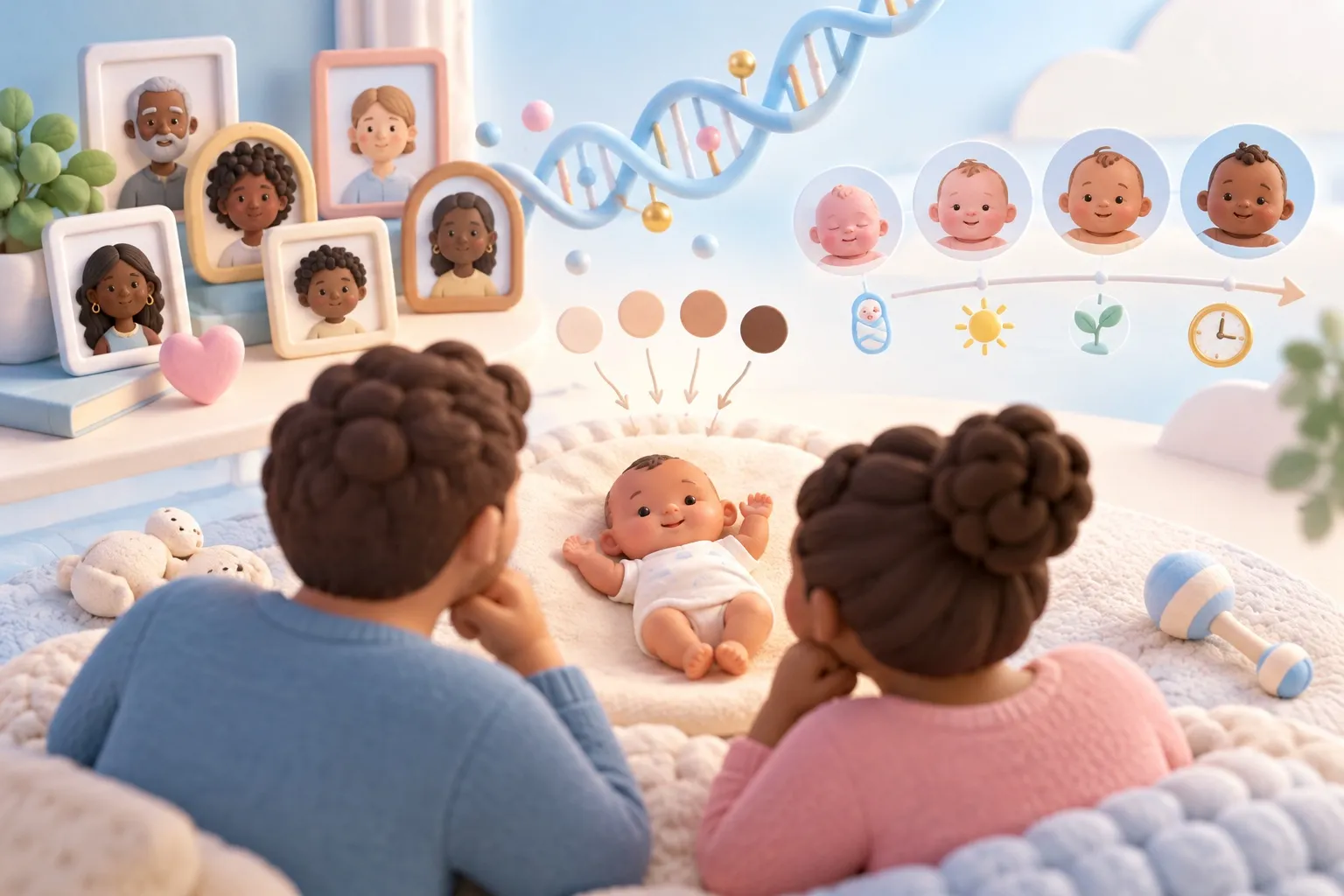
Don’t judge skin tone in the first days. The AAP says that all babies, including those with a dark-skinned heritage, have lighter-appearing skin at birth, and that it gradually darkens as they get older. Our guide to baby skin tone covers the genetics and the newborn color changes in detail.
Nose, chin and face shape: the hardest to call
Face shape is strongly family-linked, but science can only explain small pieces of it. A genome-wide study of about 6,000 Latin Americans (Adhikari et al., Nature Communications, 2016) found gene regions tied to the width of the nose bridge, the width of the nostrils, the angle of the tip and how far the chin sticks out. Each one explains only a sliver of the variation you see in a family photo.
At birth, faces also hide a lot. The AAP describes the general puffiness of a newborn’s face as mostly caused by pressure during labor, fading within days. Babies share round cheeks, a small nose and a short chin, and the features that make a face look like Mom’s or Dad’s tend to show up later, as the nose and jaw grow. That’s also why research on whether babies look like Mom or Dad finds strangers can’t reliably match most young babies to one parent. For what shifts and when, see how baby faces change.
Height: mostly genetic, but not fixed
Height is the trait where genes explain the most. MedlinePlus Genetics estimates that about 80% of a person’s height is determined by inherited DNA variations, and more than 700 variants have been found so far. The other 20% is environment: nutrition during pregnancy and childhood, infections, health care and living conditions.
In practice, children tend to land near the average of their parents, give or take, and a baby’s length at birth tells you little about adult height.
Make your own family guess
The most useful thing you can do is look wider than the two of you. Because many trait variants are carried without showing, grandparents and siblings tell you what’s hiding in each family. Try this:
- List each trait for both families: eye color, hair color, hair texture, dimples, freckles, height. Include all four grandparents and any siblings.
- Mark what shows up on both sides. A trait that appears in both families, even skipping a generation, is a stronger bet than one that appears on one side only.
- Mark the surprises. A blue-eyed grandparent on each side, or a redhead on each side, means those “hidden” traits are in the mix.
- Leave room for the unexpected. Traits like dimples are thought to run in families, but MedlinePlus notes that little research has been done and the genes involved are unknown.
You’ll end up with a range, not an answer. That’s the honest output of any genetics guess.
Picturing one possible face with SeeMyBaby
If you’d like to see one version of that range, the SeeMyBaby parents’ photo portrait takes one photo of each of you and imagines a newborn who blends your features. You can tell the app what you’re most curious about, such as eyes, hair or family resemblance, and the portrait leans into that.
Treat it as one imagined face, not a forecast. The app can’t know which genes your baby inherits, and as the sections above show, neither can anyone else yet. If you’re curious about later, the 4-year-old preview imagines the same child at age 4.
Sources
- MedlinePlus Genetics (National Library of Medicine): Is eye color determined by genetics?, Is hair color determined by genetics?, Is hair texture determined by genetics?, Is height determined by genetics? and Are dimples inherited?
- Cleveland Clinic: When do babies’ eyes change color?
- American Academy of Pediatrics, HealthyChildren.org: How Your Newborn Looks
- Adhikari K, et al. A genome-wide association scan implicates DCHS2, RUNX2, GLI3, PAX1 and EDAR in human facial variation. Nature Communications, 2016.
More looks and genetics guides are on the SeeMyBaby blog.
Questions parents ask
Which parent’s genes are more dominant?
Neither. Your baby gets half of their DNA from each of you, and for most visible traits no single parent’s version “wins”. Many genes add up, so features usually blend or mix.
Can you predict what your baby will look like?
Not reliably. Genetics can tell you which eye or hair colors are likely, but face shape depends on many genes that are still poorly understood, and features keep changing through the toddler years.
Do babies get their looks from the mother or the father?
From both, about equally. Studies of newborns found strangers matched babies to their mothers slightly more often in the first days, but most children resemble both parents.
When can you tell what a baby will look like?
Eye color often settles in the first year and can take up to three years. Hair is often replaced in the first six months, and face shape keeps changing through early childhood.