By Sarina Gomez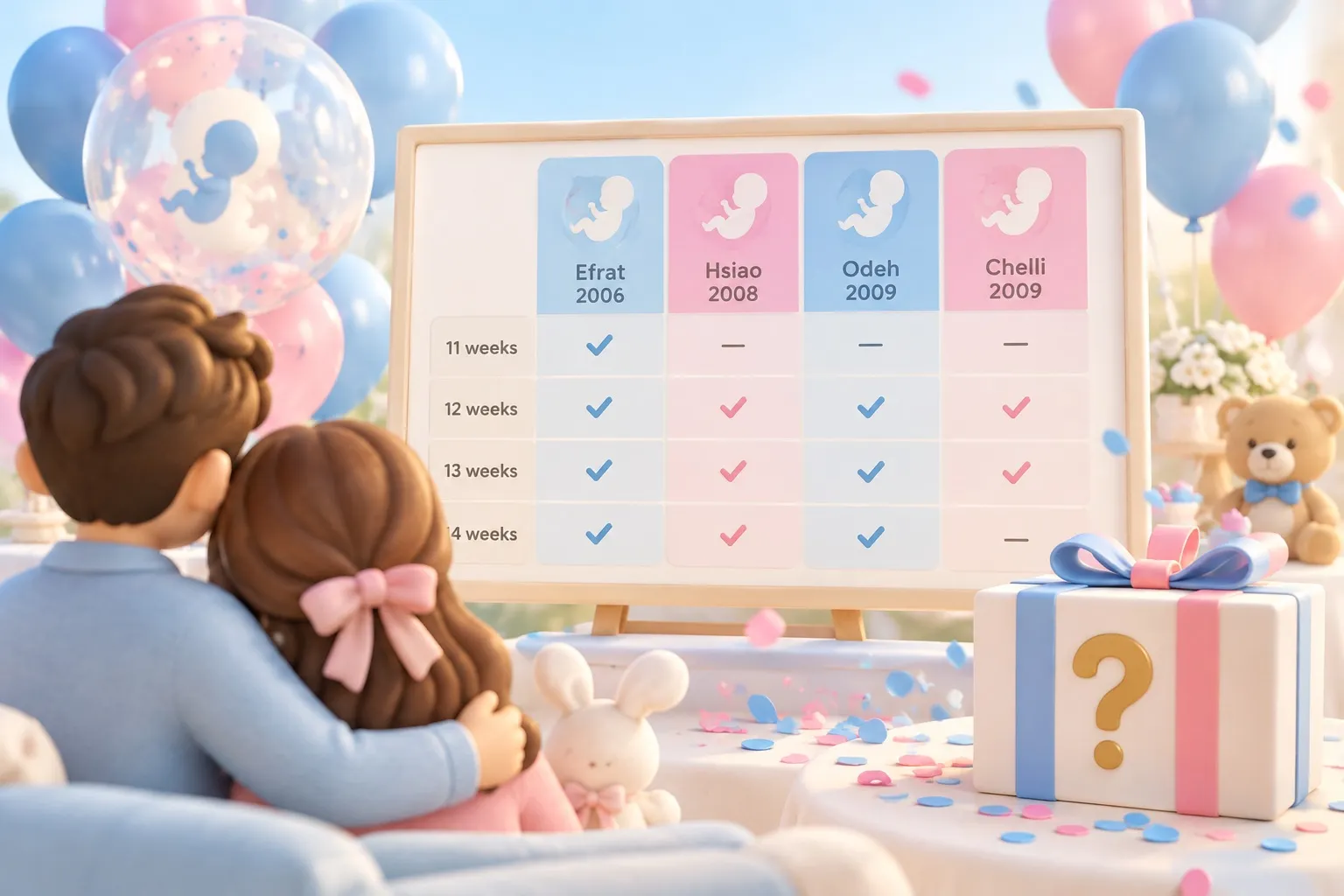
This article is general information, not medical advice. Ask your midwife, OB-GYN or sonographer about your own pregnancy and scans.
Nub theory works better than any old wives’ tale, but only in the right hands and at the right week. In published studies, trained sonographers measuring the “nub” on a live scan were right about 92% of the time at 12 weeks and 98–100% from 13 weeks, but closer to 70% at 11 weeks. Nobody has studied how well parents do reading a printout at home, and that’s where most nub guesses happen.
What nub theory actually looks at
The “nub” is the genital tubercle, the small bump between the legs that later becomes either a penis or a clitoris. Early in pregnancy it looks much the same in boys and girls. What differs is its angle.
The method most studies use comes from a 2006 Israeli study (Efrat et al., Ultrasound in Obstetrics & Gynecology):
- The baby is viewed in an exact side profile, called the mid-sagittal plane.
- A line is drawn along the skin over the lower spine.
- The angle of the nub against that line is measured.
- More than 30 degrees (pointing up): boy.
- Under 10 degrees, parallel or pointing down: girl.
- Between 10 and 30 degrees: no call.
That middle zone matters. A rule that says “can’t tell” for some babies is honest; most online nub readers never say it.
The primary studies, week by week
Accuracy climbs steeply between 11 and 13 weeks, which is why quoted figures range so widely. These are the original studies, not the numbers that get passed around forums.
| Study | Babies | Weeks | Sex called | Correct when called |
|---|---|---|---|---|
| Efrat 2006, Ultrasound Obstet Gynecol | 656 | 12–14 | 93% | Boys 99–100% at every age. Girls 91.5% at 12+0 to 12+3, 99% at 12+4 to 12+6, 100% from 13 weeks |
| Hsiao 2008, Acta Obstet Gynecol Scand | 496 | 11 to 13+6 | 441 of 496 | 71.9% at 11 weeks, 92% at 12, 98.3% at 13 |
| Chelli 2009, Prenatal Diagnosis | 312 | 11–14 | 89.7% | 85.7% overall |
| Bogers 2018, J Clin Ultrasound | 112 | 9–13, 3D | — | At best 56% from genital appearance |
A 2009 review by Odeh and colleagues draws the practical line: sonographers shouldn’t attempt the sex before 12 weeks because it’s relatively inaccurate that early, while after 13 weeks it’s accurate in 99–100% of babies with normally formed genitalia (Odeh et al., Obstetrical & Gynecological Survey).
Two details in these numbers are easy to miss:
- “Correct when called” leaves out the babies who couldn’t be read. In Hsiao’s study, 39 of the 55 babies whose sex couldn’t be determined were at 11 weeks, about 41% of that age group.
- The studies don’t agree. Chelli’s team, using the same angle rule, got 85.7% across 11–14 weeks, lower than the other two. A study using 3D ultrasound at 9–13 weeks concluded that accurate first-trimester sex determination wasn’t possible at all.
Why “12 weeks” is the tricky week
At 12 weeks, a few days make a large difference. In the Efrat study, girls were called correctly 91.5% of the time in the first half of week 12 and 99% in the second half. Male nubs also tilt further upward as the baby grows (Chelli et al.), so an early boy can sit in the “can’t tell” zone, or even look like a girl.
That’s why the authors of the Efrat study advised waiting for a larger crown-rump length before relying on an early “girl” call for medical decisions.
The other catch is that “the 12-week scan” is a label, not an exact date. The NHS offers its dating scan at around 10 to 14 weeks, and your week on the day is set by the baby’s measurements, which can move your dates. A nub photographed at “12 weeks” may really be 11+4, where the studies are much shakier.
Reading the nub on your own printout
Every number in the table came from a trained sonographer measuring a true side profile on the machine. Your printout is a different thing:
- The angle may be off. If the baby is turned even slightly, the nub’s angle on paper changes. The studies only used exact mid-sagittal views.
- Other parts get in the way. The umbilical cord, the legs and the tailbone can each look like a nub.
- There is no reference line. The studies measured against a line along the skin of the lower back; without it, “pointing up” has nothing to point against.
- Female calls are the weaker ones. A downward nub can occasionally belong to a boy; Odeh’s team reported a 14-week baby called a girl from a downward nub who turned out to be a boy with hypospadias (Odeh et al., J Clin Ultrasound, 2008).
If you want to try anyway, ask the sonographer whether the image is a true side profile. If your clinic is willing, ask directly what they see. And if your scan is before 12 weeks by measurement, treat any reading as a coin flip. Our guide to the 12-week scan explains what that appointment is actually for.
If you’d rather wait: a reveal instead of a guess
Plenty of parents skip the nub hunt and keep the sex a surprise until the 20-week scan or the birth. If that’s you, the SeeMyBaby gender reveal party is a way to make a moment of the wait. You pull the ribbon on a gift box; after you buy the gender add-on on the paywall, it opens on a drumroll with pink or blue balloons and confetti. SeeMyBaby doesn’t read the nub or analyse your scan for sex. What it shows is a playful AI guess, just for fun, not a medical result. If you already know the sex, you tell the app and no guess is made.
Better ways to know the sex
If you need a reliable answer, two routes beat the nub:
- Cell-free DNA screening. ACOG notes this blood test can be done from 10 weeks and looks at the sex chromosomes (ACOG, prenatal genetic screening tests). Ask your provider whether your result can include the sex.
- The anatomy scan. ACOG says the standard exam is usually done at 18–22 weeks and that the sex may be visible if the baby is in a good position (ACOG, ultrasound exams). In England, the NHS notes you may be asked whether you want to know at the 20-week scan.
The full timeline is in when can you find out the gender. If you’re comparing early-scan theories, Ramzi and skull theory have far less behind them than the nub, and the boy or girl old wives’ tales have less still. More guides are on the SeeMyBaby blog.
Sources
- Efrat Z et al. Fetal gender assignment by first-trimester ultrasound. Ultrasound in Obstetrics & Gynecology, 2006.
- Hsiao CH et al. Fetal gender screening by ultrasound at 11 to 13+6 weeks. Acta Obstetricia et Gynecologica Scandinavica, 2008.
- Chelli D et al. Fetal sex assignment by first trimester ultrasound: a Tunisian experience. Prenatal Diagnosis, 2009.
- Odeh M et al. Sonographic fetal sex determination. Obstetrical & Gynecological Survey, 2009.
- Odeh M et al. Hypospadias mimicking female genitalia on early second trimester sonographic examination. Journal of Clinical Ultrasound, 2008.
- Bogers H et al. Accuracy of fetal sex determination in the first trimester of pregnancy using 3D virtual reality ultrasound. Journal of Clinical Ultrasound, 2018.
- ACOG. Prenatal genetic screening tests and Ultrasound exams.
- NHS. 12-week scan and 20-week screening scan.
Questions parents ask
How accurate is nub theory at 12 weeks?
In the primary studies, trained sonographers measuring a live side view were right about 92% of the time at 12 weeks, with accuracy rising through the week. At 11 weeks it fell to about 72%, and many babies couldn’t be read at all.
Can you see the nub at 11 weeks?
Often not clearly. In one study about 41% of 11-week babies couldn’t be assigned a sex, and those that could were right only about 72% of the time.
What does a boy nub look like vs a girl nub?
In the studies, a nub angled more than 30 degrees upward from the line of the lower spine was called a boy, and one parallel or pointing down (under 10 degrees) was called a girl. Anything in between was left uncalled.
Is nub theory more accurate than Ramzi theory?
Yes. Nub theory has several peer-reviewed studies behind it when done by trained sonographers; Ramzi theory has never been confirmed in a published study.
Can a sonographer tell the sex at the 12-week scan?
Some can and will, but the scan’s purpose is dating and screening, and policies differ by clinic. The Odeh review advises against attempting it before 12 weeks.

Also available in: العربية · Deutsch · Español · Français · Italiano · 한국어 · Português (Brasil)